Tony Pearce
Judas is the most notorious character in the Bible. Even people who don’t know much about Christianity know that Judas Iscariot betrayed Jesus Christ. His name has entered into the English language as the symbol of treachery and deceit.
The story of Judas raises questions about the nature of good and evil, the church’s relationship to the Jewish people and the fulfilment of Bible prophecy.
Judas and the Jewish people
Judas’ name in Hebrew is Yehuda or Judah, first mentioned in the Bible as one of the sons of Jacob, from whose tribe was to come the royal line of David and the Messiah (Genesis 49.10). The words Judea, Jew and Judaism and their equivalents in other languages derive from the name Judah. Where the name Iscariot comes from is more debatable. Most likely it means ‘Ish Karioth’, a man of Karioth, a town in Judea, which would have marked Judas out as being different from the Galilean disciples of Jesus. Another possibility is that it is connected to the ‘Sicarii’, the dagger men, a group of zealots dedicated to driving Romans out of Judea.
The connection between Judas and the Jewish people became a source of anti-Semitism in Christendom. Throughout Europe it was common for boys to be given the names of the disciples of Jesus in the form common to their languages – Peter, Andrew, James, John. No Christian boy would ever be called Judas, although Jewish boys would be called Yehuda. In Medieval Christendom the common people had no access to the Bible in languages they could understand, so they were ignorant of much of what the New Testament taught.
Anti Jewish prejudice and ignorance in the established churches meant they would not have known about the Jewishness of Jesus and His disciples all of whom had Hebrew names, Yeshua (Jesus), Kefa (Peter), Yakov (James) and Yohannan (John). So most people assumed that Peter, Andrew, James and John were all nice Gentile Christians, whereas the only Jewish disciple of Jesus was Judas the traitor. Often Medieval paintings depicting the disciples show Judas having obviously Jewish features whereas the other disciples and Jesus look like good Europeans. All of this gave rise to antisemitism in the name of Jesus, which was the exact opposite of the intention of Jesus Himself and the Gospel writers.
Why did Judas betray Jesus?
Judas’ name first appears in the Gospels of Matthew, Mark and Luke in the list of the twelve disciples. In each list Peter is the first mentioned and Judas the last. Only Judas has something added to his name, ‘Judas Iscariot who betrayed him.' Matthew 10.4.
Judas was fully part of the twelve disciples, involved in the preaching of the Gospel: ‘And when He had called His twelve disciples to Him, He gave them power over unclean spirits, to cast them out, and to heal all kinds of sickness and all kinds of disease. … These twelve Jesus sent out and commanded them, saying: “Do not go into the way of the Gentiles, and do not enter a city of the Samaritans. But go rather to the lost sheep of the house of Israel. And as you go, preach, saying, ‘The kingdom of heaven is at hand.' Matthew 10.1-7.
Judas must have taken part in those missions. He saw the power of God operating through Jesus and the disciples, the sick being healed, the dead raised and demons cast out. He heard His teaching, the Sermon on the Mount, the parables. He had close fellowship with the Son of God for three years. So how could someone who had been close to Jesus for three years, seen His miracles and heard His teaching betray Him for thirty pieces of silver?’
We are not told anything about his motive. All we are told is that Satan entered into him:
'Now the Feast of Unleavened Bread drew near, which is called Passover. And the chief priests and the scribes sought how they might kill Him, for they feared the people. Then Satan entered Judas, surnamed Iscariot, who was numbered among the twelve. So he went his way and conferred with the chief priests and captains, how he might betray Him to them. And they were glad, and agreed to give him money. So he promised and sought opportunity to betray Him to them in the absence of the multitude.' Luke 22.1-6. See also John 13.2.
Satan is a real being, more powerful than humans, but infinitely less powerful than God. He was created by God as a mighty archangel, but fell from his high position in heaven when he rebelled against God when his heart was lifted up because of his beauty (Ezekiel 28.17) and he wanted to be like God (Isaiah 14.14). As a result he was cast out of heaven and become the tempter who caused sin and rebellion against God on earth. See Genesis 3, Isaiah 14.12-14, Ezekiel 28.11-19. Jesus called him the ruler of this world (John 11.31), acknowledging his temporary power over the affairs of humanity in rebellion against God. See also Matthew 4.8-10.
The case of Judas tells us that even In the presence of the Lord Jesus It Is possible for Satan to enter in and influence us. Perhaps this explains why many so called ministers of the church end up doing the devil’s work, not God’s. Peter tells us to ‘Be sober, be vigilant; because your adversary the devil walks about like a roaring lion, seeking whom he may devour. Resist him, steadfast in the faith, knowing that the same sufferings are experienced by your brotherhood in the world.' 1 Peter 5.8-9.
The only one who has walked this earth without falling at some time to the influence of the devil was Jesus Himself, who was tempted as we are but overcame him by obedience to God and the Word of God. Matthew 4.1-11, Hebrews 2.18, 4.15.
One lesson we can learn from this is that we should be aware of the ever present danger of satanic activity. Even at the moment we are praying or praising the Lord something of the evil one may be lurking around trying to get to us. He may slip into our minds thoughts like these: ‘You don’t belong here, God doesn’t care about you, this is all a myth, a made up story which no one believes today.’
Our protection against the devil comes from
- Knowing the Word of God. In the temptation accounts Jesus resisted the devil by quoting the word of God to him. Matthew 4.1-11.
- Submission to the will of God. ‘Therefore submit to God. Resist the devil and he will flee from you.' James 4.7.
- Confessing our sin and being cleansed by the blood of Jesus: ‘The blood of Jesus Christ His Son cleanses us from all sin….If we confess our sins, He is faithful and just to forgive us our sins and to cleanse us from all unrighteousness.' 1 John 1.7-9.
The devil can also use other people to influence us away from God’s purpose and get us to fulfil their wrong purpose, by sowing doubts in our hearts, causing unbelief and separating us from other believers.
It is possible that on a human level this is what happened to Judas, which made him open to the evil plan of the enemies of Jesus. The Gospels reveal that Jesus had enemies in the Sanhedrin, the Jewish religious establishment (also that the friends and supporters of Jesus were all Jewish). His enemies were infuriated by the preacher from Galilee who denounced their hypocrisy (Matthew 23) and made claims for Himself they considered blasphemous (John 8, Matthew 26.62-66). They were afraid of His influence on the people, especially the claim that He was the Messianic King of the line of David (Luke 19.37-40, John 11.45-52).
This was especially dangerous at the time of Passover when there were crowds of pilgrims in Jerusalem and Jesus was there preaching in the Temple precincts to people who were attentive to His words and heard Him gladly (Matthew 21.14-16, Mark 12.37). The fear was that He would cause a public commotion among the Passover crowd that would cause the Roman occupiers to take action against the Jewish people.
So they wanted to arrest Jesus quietly to prevent this from happening: ‘Then the chief priests, the scribes, and the elders of the people assembled at the palace of the high priest, who was called Caiaphas, and plotted to take Jesus by trickery and kill Him. But they said, ‘Not during the feast, lest there be an uproar among the people.' Matthew 26.1-5.
Judas then steps in as one who knows Jesus’ daily routine and will be able to take them to a place where Jesus can be arrested secretly. ‘Then one of the twelve, called Judas Iscariot, went to the chief priests and said, “What are you willing to give me if I deliver Him to you?” And they counted out to him thirty pieces of silver. So from that time he sought opportunity to betray Him.”’ Matthew 26.14-16.
Did Judas have some connection to the chief priests and so went to them to offer his services to deliver up Jesus in a quiet place where He could be arrested without causing an uproar? Maybe in the times in the Temple when Jesus was preaching, someone from the priests’ side had mingled with the crowd and spoken to Judas and found that he had some doubts about Jesus and so recruited him to their cause.
Another possibility is that Jesus was not turning out to be the kind of Messiah Judas was looking for. Some commentators say Judas was a zealot sympathiser, wanting the Messiah to rid Judea of Roman rule and had become frustrated at Jesus’ nonviolent message of loving your enemies and turning the other cheek (Matthew 5.43-48).
While the Gospel writers do not tell us about Judas’ motive, John does tell us that he had a weakness for money. At the anointing at Bethany we read:
'But one of His disciples, Judas Iscariot, Simon’s son, who would betray Him, said, “Why was this fragrant oil not sold for three hundred denarii and given to the poor?” This he said, not that he cared for the poor, but because he was a thief, and had the money box; and he used to take what was put in it.' John 12.1-7.
So, we know that that Judas was dishonest and therefore open to Satanic influence which at the crunch point made him disloyal to Jesus to the point of betraying Him. He was then recruited by the chief priests with the offer of money to do their bidding.
The arrest
The place of the arrest at Gethsemane is significant. It is across the Kidron Valley on the east side of Jerusalem, at the foot of the Mount of Olives on the road from Jerusalem to Bethany. The Gospels tell us that during the final week before the crucifixion Jesus was daily teaching in the Temple precincts and then went to Bethany to stay overnight. Then He left them and went out of the city to Bethany, and He lodged there. Matthew 21.17. The Gospels record that Jesus had friends in Bethany whose homes He visited (Luke 10.38-42, Matthew 26.6).
John Wenham in his book ‘Easter Enigma’, a fascinating reconstruction of the events of Holy Week, links Gethsemane to the family of Mary, the mother of John Mark, author of Mark’s Gospel. According to Acts 12.12 the disciples met in their house after the resurrection. Christian tradition says this house was likely the scene of the Upper Room where the Last Supper took place. Having a large house in this quarter of Jerusalem meant the family was quite wealthy. The source of their wealth may have been the garden of Gethsemane, a working olive press situated just outside the city in the Kidron Valley. Gethsemane in Hebrew is ‘gat shemanim’ meaning place of the olive press.
There is a curious detail given in the Gospel of Mark of the young man who fled away naked at the time of the arrest of Jesus (Mark 14.51-52). Wenham says this was probably Mark himself who was keeping watch over the property, sleeping in a room on the premises. He was then disturbed by the commotion and fled away when Jesus was arrested.
The family of Mark could have made Gethsemane available to Jesus and the disciples, a quiet place of rest and prayer on the way back from Jerusalem before they climbed up the hill to Bethany. Judas would have known that this was Jesus’ pattern of behaviour and been able to lead the arresting party to where Jesus was, alone with his disciples and out of view of the crowds, fulfilling the requirement of the chief priests that Jesus be arrested without a public commotion. If Jesus had left Gethsemane by the time the arresting party got there, Judas would have led them up the hill to Bethany where they could arrest Him.
As the arresting party approaches Gethsemane we read: ‘Now His betrayer had given them a sign, saying, “Whomever I kiss, He is the One; seize Him.” Immediately he went up to Jesus and said, “Greetings, Rabbi!” and kissed Him. But Jesus said to him, “Friend, why have you come?” Then they came and laid hands on Jesus and took Him.'
Jesus the Messiah was betrayed by a kiss, the gesture of friendship. He responds by addressing Judas as friend and asking him why have you come? One can only imagine what went through the mind of Judas as he heard those words. ‘Why does he call me friend while I am betraying him? Why have I done this? Where is this going now?'
It would not take long for Judas to know the answer. Perhaps if he had paid attention to previous words spoken by the Lord he would have realised that what was happening was exactly what Jesus had told them would happen, His arrest, trial, crucifixion, burial and resurrection on the third day (Matthew 16.21). Judas may have had a terrible premonition that he was now on the wrong side of the most significant event in history, that would change the world and his destiny forever.
Judas’ remorse and death
When he did come to realise what he had done it was too late to undo it. The Sanhedrin had decided that Jesus should die, and handed Him over to Pilate for sentencing and execution.
'When morning came, all the chief priests and elders of the people plotted against Jesus to put Him to death. And when they had bound Him, they led Him away and delivered Him to Pontius Pilate the governor.
Then Judas, His betrayer, seeing that He had been condemned, was remorseful and brought back the thirty pieces of silver to the chief priests and elders, saying, “I have sinned by betraying innocent blood.”
And they said, “What is that to us? You see to it!”
Then he threw down the pieces of silver in the temple and departed, and went and hanged himself. But the chief priests took the silver pieces and said, “It is not lawful to put them into the treasury, because they are the price of blood.” And they consulted together and bought with them the potter’s field, to bury strangers in. Therefore that field has been called the Field of Blood to this day.' Matthew 27.1-8.

The text tells us that Judas was remorseful (AV says ‘repented himself’). Matthew does not use the usual New Testament word for repent in the Greek (metaneo) but a less usual word ‘metamelomai’. This word does not have the same force as ‘repent’ used in the biblical sense, but implies a remorse of the kind experienced by a wrong doer who is found out and regrets what he has done.
So Judas in bitter remorse and understanding the enormity of the sin he had committed went out and hanged himself. In Acts 1.25 Peter describes Judas as one who ‘fell by transgression and went to his own place’. It is not totally clear whether Peter meant the place Judas went to was the grave in Akel Dama (Field of Blood) or hell by this phrase. As he did not truly repent and believe the Gospel we have to assume that he went to hell.
In Jesus’ prayer for the disciples in John 17 He marks Judas out as the ‘son of perdition’:
'Those whom You gave Me I have kept; and none of them is lost except the son of perdition, that the Scripture might be fulfilled.'
Perdition means ‘lostness’ so the implication is that Judas was destined to play the role of the betrayer and be lost for eternity. Interestingly the only other reference to the ‘son of perdition’ in the New Testament is in 2 Thessalonians 2.3 referring to the man of sin or the Antichrist.
Fulfilment of prophecy
Judas Iscariot fulfilled specific Old Testament prophecies concerning the betrayal of the Messiah, His betrayal by a close friend, the specific price of the payment, and the fate of the money.
The Betrayal by a Trusted Companion:
The Prophecy: Psalm 41.9 foretold, “Even my close friend in whom I trusted, who ate my bread, has lifted his heel against me.”
The Fulfilment: Jesus directly identified Judas as the fulfilment of this prophecy at the Last Supper, noting that the one who shared His bread would betray Him (John 13.18). At the moment of the arrest Jesus addressed Judas as ‘friend.'
The Betrayal for 30 Pieces of Silver:
The Prophecy: Zechariah 11.12-13 prophesied that the Messiah would be valued at thirty pieces of silver, which is later thrown “to the potter in the house of the Lord”.
The Fulfilment: Judas agreed to betray Jesus to the religious leaders for exactly 30 pieces of silver (Matthew 26.15). After feeling remorse, he returned the coins to the Temple.
Purchasing a Potter’s Field:
The Prophecy: Zechariah 11.13 explicitly states the rejected wages would be thrown “to the potter”.
The Fulfilment: Because the 30 pieces of silver were “blood money” and could not be put into the treasury, the religious leaders used them to buy a potter’s field to bury strangers (Matthew 27.3-10)
The potter’s field / Akel Dama / Field of Blood
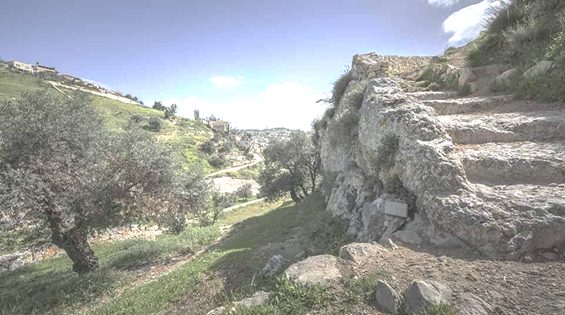
Judas’ final burial place is in Akel Dama, Hebrew for field of blood, in the ‘potter’s field’. Both Matthew and Acts refer to Akel Dama in connection with Judas’ death (Matthew 27.8, Acts 1.19). ‘And they consulted together and bought with them the potter’s field, to bury strangers in. Therefore that field has been called the Field of Blood (Akel Dama) to this day.' Matthew 27.8.
'And it became known to all those dwelling in Jerusalem; so that field is called in their own language, Akel Dama, that is, Field of Blood.' Acts 1.19.
Akel Dama is located in the Hinnom Valley, near the junction with the Kidron Valley, facing the southern walls of Mount Zion, Jerusalem. In biblical times it was a site of pagan rituals including child sacrifice and became known as a metaphor for hell. In New Testament times it was a municipal dumping ground for refuse, dead animals, and the bodies of executed criminals. Because continuous fires were used in the valley to burn refuse and bodies, its Hebrew name, Gei Hinnom, (Greek Gehenna) became the word used for hell in the New Testament.
In Matthew 27 Judas throws the 30 pieces of silver into the Temple sanctuary and goes away to hang himself. The chief priests then buy the potter’s field as a burial place. In Acts 1.18-19 Peter describes Judas as having purchased the field himself ‘and falling headlong, he burst open in the middle and all his entrails gushed out.’ So we have two descriptions of what happened to Judas – that he hanged himself and that he burst open in the middle and his entrails gushed out.
Arnold Fruchtenbaum gives an interesting explanation of this apparent discrepancy in his book ‘Messianic Christology’ (page 153-4). ‘Judas committed suicide at the end of the first night of the Passover, before the first day of the Passover when the Passover sacrifice would be offered. According to Jewish law if there was a dead body within the walls of Jerusalem then the city would be considered defiled and the morning sacrifice could not be offered. However if the corpse is taken and thrown into the Valley of Hinnom, then the city would be cleansed and the sacrifice may be offered up. In order for this to happen Judas’ body was thrown over the walls into the valley as a result of which his entrails gushed out. So Matthew is right that Judas hanged himself and Acts is right that his body burst open when it was thrown over the walls into the valley below.'
Concerning the issue of who bought the burial place, Arnold Fruchtenbaum again has the answer. ‘What were the Chief Priests to do with the 30 pieces of silver? The money was wrongfully gained so it could not be put back into the Temple treasury. Such money could either be returned to the owner or used for the public good. Since Judas was already dead it could not be returned to him so it had to be used for the common good. So a field was purchased in the name of the deceased Judas Iscariot by the chief priests as a burial place. The first person to be buried there was Judas himself. So Matthew is right when he says the chief priests bought the field. Acts is also right that Judas Iscariot was the legal owner since the field was bought posthumously in his name.'
Jeremiah or Zechariah – who made the prophecy?
There is also an issue about the connection between this event and Hebrew prophecy.
Matthew 27.9-10 attributes Judas’ actions to the prophecy of Jeremiah not Zechariah. ‘Then was fulfilled what was spoken by Jeremiah the prophet, saying, “And they took the thirty pieces of silver, the value of Him who was priced, whom they of the children of Israel priced, and gave them for the potter’s field, as the LORD directed me.”’
In fact Jeremiah does not refer to 30 pieces of silver, though Zechariah does.
'And the Lord said to me, “Throw it to the potter”—that princely price they set on me. So I took the thirty pieces of silver and threw them into the house of the Lord for the potter.' Zechariah 11.12-13.
So did Matthew make a mistake attributing the prophecy to Jeremiah not Zechariah? The footnote to some Bibles connects Matthew 27.9 to Jeremiah 32.6-9 which is a reference to Jeremiah buying a field at Anathoth for seventeen shekels of silver. This footnote is wrong. Jeremiah 32 is about a land transaction Jeremiah made, which has nothing to do with Matthew’s prophecy about the events surrounding Judas and the Potter’s Field.
The real connection to Jeremiah is not chapter 32 but chapters 18-19. The explanation of this is to be found in David Baron’s commentary on Zechariah page 409-412. Baron was a Hebrew Christian who came to the Lord in the 19th century from a rabbinic background and was an expert in Hebrew studies of the New Testament. He shows how Matthew’s quote is a composite reference to both Zechariah 11.12-13 (thirty pieces of silver) and Jeremiah 19 (the potter’s field). Such composite quotes are common in Jewish writings.
Jeremiah 18-19, the potter’s house and the potter’s field, are part of a prophecy of the coming judgement on Judea and Jerusalem for their sin and rebellion against God. Jeremiah is told by the Lord to take the pot from the potter’s house and smash it in the potter’s field as a symbol of this coming destruction. Jeremiah explains that the broken pot is a sign that the Valley of Hinnom will become known as the Valley of Slaughter (Jeremiah 19.6). In so doing he was making a prophecy of the coming destruction of Jerusalem and its Temple by the Babylonians. When this happened the Valley of Hinnom became the place of slaughter.
In context Zechariah 11 is a prophecy of the destruction of the second temple by the Romans when this would happen again in the same place, the Valley of Hinnom. The two passages in Jeremiah and Zechariah are connected by a common theme – the destruction of the temple and the reason for it. The reason for the fall of the First Temple and the Babylonian captivity was disobedience of Israel to the Torah and the rejection of the message of the prophets. The reason for the destruction of the Second Temple and the greater dispersion of Israel was to be the rejection of the Messiah and His message by the religious leaders.
Judas’ act of betrayal and its use by the Sanhedrin in arranging the arrest, trial and crucifixion set the stage for this event to take place. 40 years after the death and resurrection of the Lord Jesus, the Romans broke through the walls of Jerusalem in 70AD. There was such an appalling slaughter that there was no more room to bury the dead in the Valley of Hinnom, which became the Field of Blood (Akel Dama). Jesus gave warning of this event saying it would happen ‘because you did not know the time of your visitation (Luke 19.44).’ In other words the reason for the coming judgment on Jerusalem was the failure of the Jewish religious leaders to recognise Jesus as the promised Messiah.
Judas’ betrayal of Jesus with the connivance of the chief priests led to His arrest, to be followed by the trial and crucifixion. Significantly the money given to Judas was taken from the fund for buying sacrifices for the Temple. So it bought the final sacrifice for sin through the blood of the Messiah Jesus. To those who accepted the meaning of this sacrifice, Jewish and Gentile, it became the source of forgiveness and eternal life. This offer went out even to those who had been responsible for the death of Jesus who could be saved through repentance and faith in His name (Acts 3.11-26). To those who rejected it, the sacrifice of Jesus became the source of judgement. Akel Dama in Gei Hinnom / ‘Gehenna’ the word used in the New Testament for hell.
The field of blood and the end of days
The Bible prophesies a scattering of the Jewish people from the land of Israel and Jerusalem being ‘trodden down (ruled by) of the Gentiles until the times of the Gentiles are fulfilled.’ (路加福音21.24). It also prophesies a return of the Jewish people to the land of Israel and Jerusalem at the end of days and shows that this will be the scene of the last days battle, as the nations gather against Jerusalem (Zechariah 12-14, Revelation 16, 19).
Joel tells us that God will act in judgement against those nations: ‘I will also gather all nations, and bring them down to the Valley of Jehoshaphat; And I will enter into judgment with them there on account of My people, My heritage Israel, whom they have scattered among the nations; they have also divided up My land.' Joel 3.2.
The Valley of Jehoshaphat is also known as the valley of decision in Joel where multitudes gather for the ‘Day of the Lord’ event. Jehoshaphat in Hebrew means ‘the Lord judges’. Scholars generally link this valley with the Kidron Valley to the east of Jerusalem, which meets the Valley of Hinnom at its south-eastern corner, the place where Judas was buried in Akel Dama. The valley serves as the ‘winepress’, the setting for God’s anger when He crushes the nations like a bunch of grapes at the time of the last battle over Jerusalem:
'So the angel thrust his sickle into the earth and gathered the vine of the earth, and threw it into the great winepress of the wrath of God. And the winepress was trampled outside the city, and blood came out of the winepress, up to the horses’ bridles, for one thousand six hundred furlongs.' Revelation 14.19-20.
Joel prophesies the same event: ‘Put in the sickle, for the harvest is ripe. Come, go down; for the winepress is full. The vats overflow— for their wickedness is great. Multitudes, multitudes in the valley of decision! For the day of the Lord is near in the valley of decision. The sun and moon will grow dark, and the stars will diminish their brightness. The Lord also will roar from Zion, and utter His voice from Jerusalem; the heavens and earth will shake; but the Lord will be a shelter for His people, and the strength of the children of Israel. So you shall know that I am the Lord your God, dwelling in Zion My holy mountain.' Joel 3.12-13.
So Akel Dama, the field of blood, plays its last role as the place of judgement at the Second Coming of the Messiah. Following that the Messiah restores the kingdom to Israel, setting up His throne in restored Jerusalem and bringing in the Messianic age of peace and justice on earth (Isaiah 2.1-4, Revelation 20).
Don’t go to Judas place in Akel Dama, Gehenna, but come into the place of safety for all who put their trust in Yeshua, Jesus the Messiah.